Talk with Aspire about improving your profit margins, cash flow, and long-term business health.


You bring real expertise to every job. The money you keep should match it, and for most builders it doesn't. Aspire for Contractors is a construction business coaching company working exclusively with residential remodelers and custom home builders across Seattle and the Puget Sound. Nobody hands a builder the blueprint to running a construction business, but Aspire teaches it, using your own job costs, labor rates, and margins. Across Aspire's coaching clients, 86% increased their net worth in the first year, workload dropped 51%, and owners have added more than $618M in profit, from working on the business, not more hours in the field. In one day, the "Where GC Profit Actually Comes From" workshop covers cost of production, cash flow, job mix, and pricing, and you leave with a Road Map built on your numbers. The two-year Business Mastery Program goes further with ongoing coaching, in-person training at Aspire's headquarters for you and your team, and a set of tools built around your numbers.
Plenty of contractors stay busy and still come up short on profit because revenue alone never guarantees healthy gross profit.
These builders started where many Seattle owners are now: busy, respected, and frustrated by the gap between the work and the money. Here's what changed once the numbers came into focus.



The "Where GC Profit Actually Comes From" workshop is a full day on construction profit margins: where they come from and where they leak out. You'll work through the true cost of production, what a fully loaded labor rate has to cover, and why a 20% markup is only a 16.7% margin. You'll see why a thin bottom line almost always traces back to one gap: gross profit and overhead sitting too close together. We also cover matrix pricing by job type, job mix, cash flow, lead quality, and hiring.
After the workshop, Aspire builds your Road Map from the financials you submitted, so it's based on your real gross profit. It lays out where your numbers actually sit, which job types and margins are worth going after, and what to change first. Then you sit down one-on-one to walk through it. It's yours to keep either way.
The Business Mastery Program is coaching built around where you want the company to go, not a set curriculum every client runs through. You're assigned a coach who knows your business and your numbers, with the rest of the team behind them. In addition to your regular coaching sessions, you and your key people come to Aspire's headquarters for in-person training. We focus on what your business needs most: pricing, job costing, cash flow, marketing, hiring, tracked in the Aspire Intelligence System™ against the goals you set.
You don't need more jobs; you need more profit. When the numbers feel tight, the instinct is to sell more work, and it's usually the one move that doesn't help; a thin margin stays thin no matter how much money runs through it. The money is already in the business; it's leaving somewhere between the estimate and the final invoice.
Most builders price the way it's always been done, cost plus a markup. Then the job wraps, you hit your markup number, and there's barely any money in it. In Seattle, where labor and insurance both run high, an hour costs far more than the rate on the check, and that gap never makes it onto the invoice.
At the workshop, you will see the real cost of an hour, why a $45 employee actually costs around $66 fully loaded, and why the national GC average net profit is only 2.4%, with most builders walking in closer to 1.59%. Once you can see it, you can finally price for it.
Aspire's method starts in the numbers, not in opinions about them. There's a specific set of costs most contractor P&Ls leave out or file in the wrong column, and a defined order for putting them back. The workshop walks through that correction, and most owners find the gross profit they've been pricing against isn't their real one.
Seattle's permitting and build timelines are long; on a custom project, money can sit tied up for the better part of two years while payroll and materials keep moving. Plenty of owners describe being profitable on paper and broke in real life, floating costs while waiting 30, 60, 90 days to get paid.
At the workshop, you will see how to get paid for the estimating and pre-construction work most builders give away, and how to forecast money in and money out six to twelve months ahead, so cash stops being the thing that keeps you up at night.
A Professional Services Agreement (PSA) is a defined process with distinct phases. The workshop covers the sequence, when it gets introduced, what each phase covers, and how it's structured so you're paid as the work happens. Around 95% of PSAs handled this way go to contract.
This is the quiet one that skims a little off every job. You add a markup, assume the percentage you add is the percentage you keep, and find out at the end that it wasn't. For a lot of owners, margin didn't mean much until it was already costing them.
At the workshop, you will see why a 20% markup is only a 16.7% margin, and why about 88 cents of every dollar disappears into production in a typical builder's business, leaving 12 cents for everything else. Then you'll see exactly how to price so the number you keep is the number you planned on.
Matrix pricing is Aspire's method for setting margin by job type instead of one flat markup across work that behaves nothing alike. The targets are calculated from your own cost structure and blended into the number your business has to hit; which is why it gets built from your figures rather than pulled off a chart.
A full Seattle calendar can be the problem. With remodels, custom builds, and ADUs all in demand, it's easy to say yes to everything and bury the jobs that actually pay under a pile that doesn't.
At the workshop, you will see the math of earning the same money on far fewer, better-fit jobs, one builder went from 57 jobs a year down to 12 and made more — so you can start picking your work instead of taking whatever calls in.
Aspire ranks work by what it contributes after it's built, not by contract size. The workshop gives you the measure and how to apply it to your own job history, so the comparison happens before you bid instead of at closeout.
Seattle's economy rides the tech sector, and construction trails the broader economy by six to eighteen months. Plenty of owners only know how to run wide-open in a boom, then get caught flat when it turns and start cutting price just to stay busy.
At the workshop, you will see how the cycle actually works and how to hold a healthy balance of income and workload through both halves of it, so a downturn becomes something you're positioned for instead of being blindsided by it.
Aspire's position is structural, not seasonal. The workshop covers how to read where the cycle sits and what to adjust, so the same discipline carries the company through both halves, and you're not running two different businesses depending on the market.
Most builders take whoever calls. The loudest client, the fastest lead, the job that showed up when the schedule had a hole, and then you're competing on price against two other bids for work that may not fit your company, at a margin you can't hold.
At the workshop, you will see leads split into two buckets: reactive, which arrive when they arrive, and targeted, which come from a process you can adjust and repeat. The goal is at least half your leads in the second bucket. You'll also see why multiple-bid situations are a sales process problem, not a market problem.
Aspire treats lead quality as something you measure, not something you hope for. There's a defined way to categorize where your work comes from and score what each source actually produces, and it usually shows the price objection was a process failure earlier in the sale.
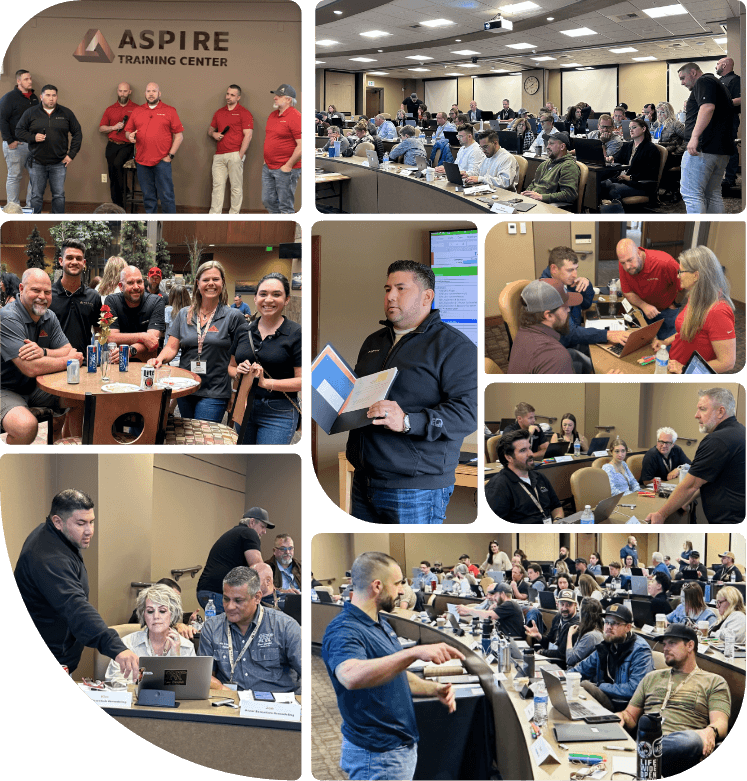
You don't leave with a binder of theory. Your Road Map gets reviewed with you one-on-one after the workshop, covering where your numbers sit now, the job types and margins worth going after, and what to change first, sized to your company rather than a general template. The day also helps you put a real number on what your people cost, including wage plus taxes, insurance, vehicles, benefits, and the hours you pay for but don't bill.
|
|
Attending the workshop starts a conversation, not a commitment. The Road Map is yours regardless of what comes next.
The GCs we work with aren't grinding harder than they used to; they're keeping more of what they were already earning. Across Aspire's coaching clients, 86% grew their net worth in the first year, average owner workload dropped 51%, and owners have added more than $618M in profit.
The two-year Business Mastery Program is where that gets built in. You work with an assigned coach who knows your company, come to Aspire's headquarters for in-person training with your key team members, and track your progress in the Aspire Intelligence System™ - a dashboard showing where you started, where you are now, and what's next. It's customized rather than a fixed curriculum, because our goal is to help you achieve the business and the life you set out to build when you started your company, not somebody else's revenue target.